
Current Financial System and Bitcoin

Introduction
"Everything is fine!" This phrase has become a common way to signal that, in reality, everything is not fine at all. We are currently witnessing the vulnerabilities of a century-old monetary system. It is a complex yet timely issue to explore how we can protect ourselves when the dollar inevitably loses its status as the world reserve currency. This transition is happening rapidly, and I argue that the adoption of Bitcoin will be the most effective means for people to preserve their wealth for the future.
Cycles of World Reserve Currencies
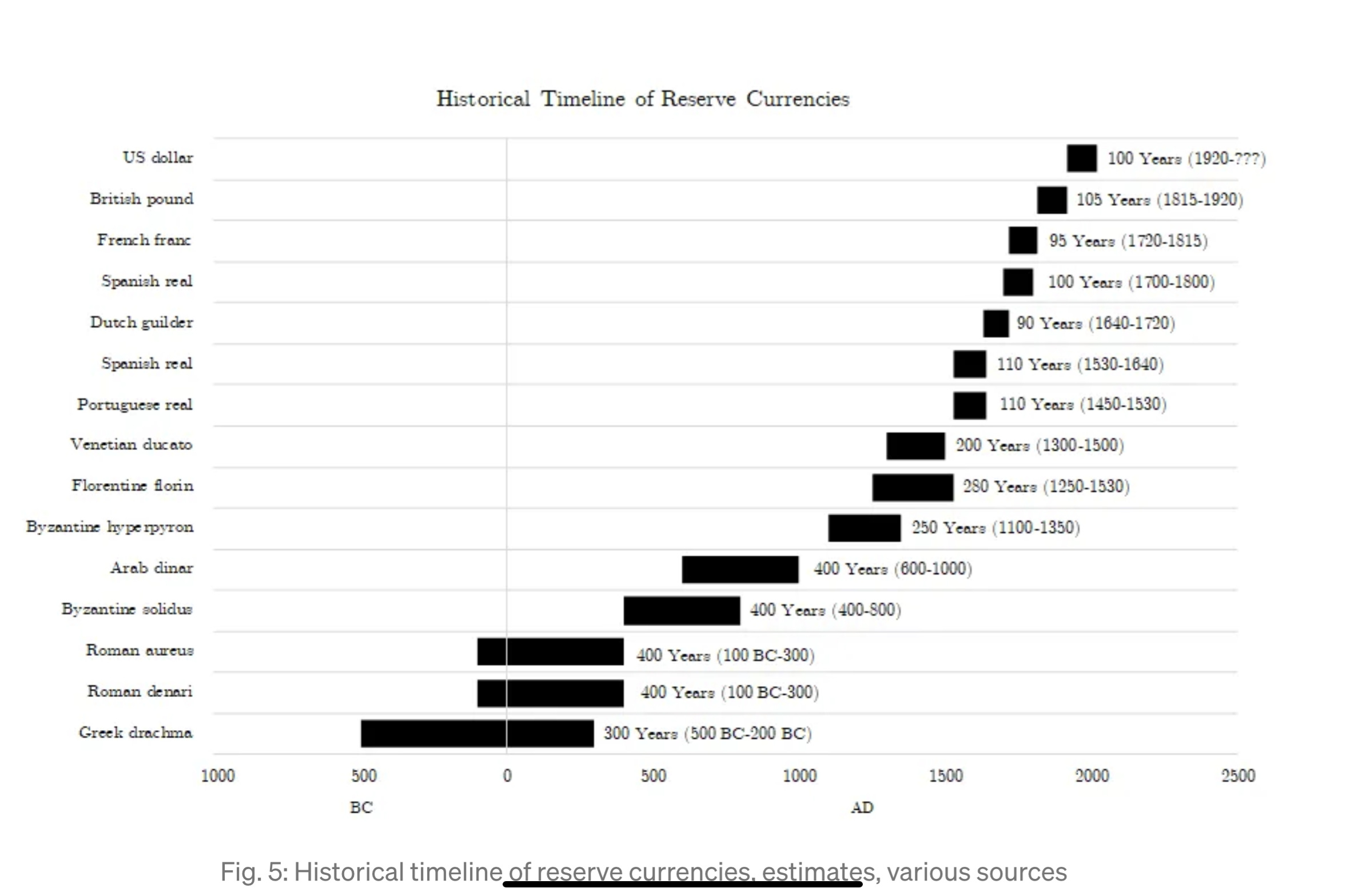
At present, the US dollar maintains its status as the world reserve currency, a position it has held for more than a century. However, like all fiat currencies, which rely on the trust and authority of the issuing government instead of an underlying commodity, there are inherent issues with fiat monetary policy. We are nearing the end of the dollar's life cycle as a world reserve currency, and it's worth noting that the previous seven world reserve currencies have typically held that status for approximately 100 years.
FED Monetary Policy
The current monetary system depends on the continuous creation of new credit, as the money supply expands through the issuance of new loans. In contrast, the value of the Dollar hinges on the inflation generated by this new credit. When new credit is created, it injects fresh money into the system, potentially leading to economic growth and increased spending. However, if new credit halts, the money supply contracts, resulting in reduced spending and economic activity. This can initiate a vicious cycle in which decreased spending leads to lower profits for businesses, causing layoffs and diminished income for individuals, further reducing spending. This cycle effectively ensures that new money will need to continue to enter the system to sustain the system. Inevitably resulting in an inflation of the money supply. We will likely see larger inflation numbers over the next few decades as maintaining the balance between the money printer and economic stability becomes increasingly challenging.
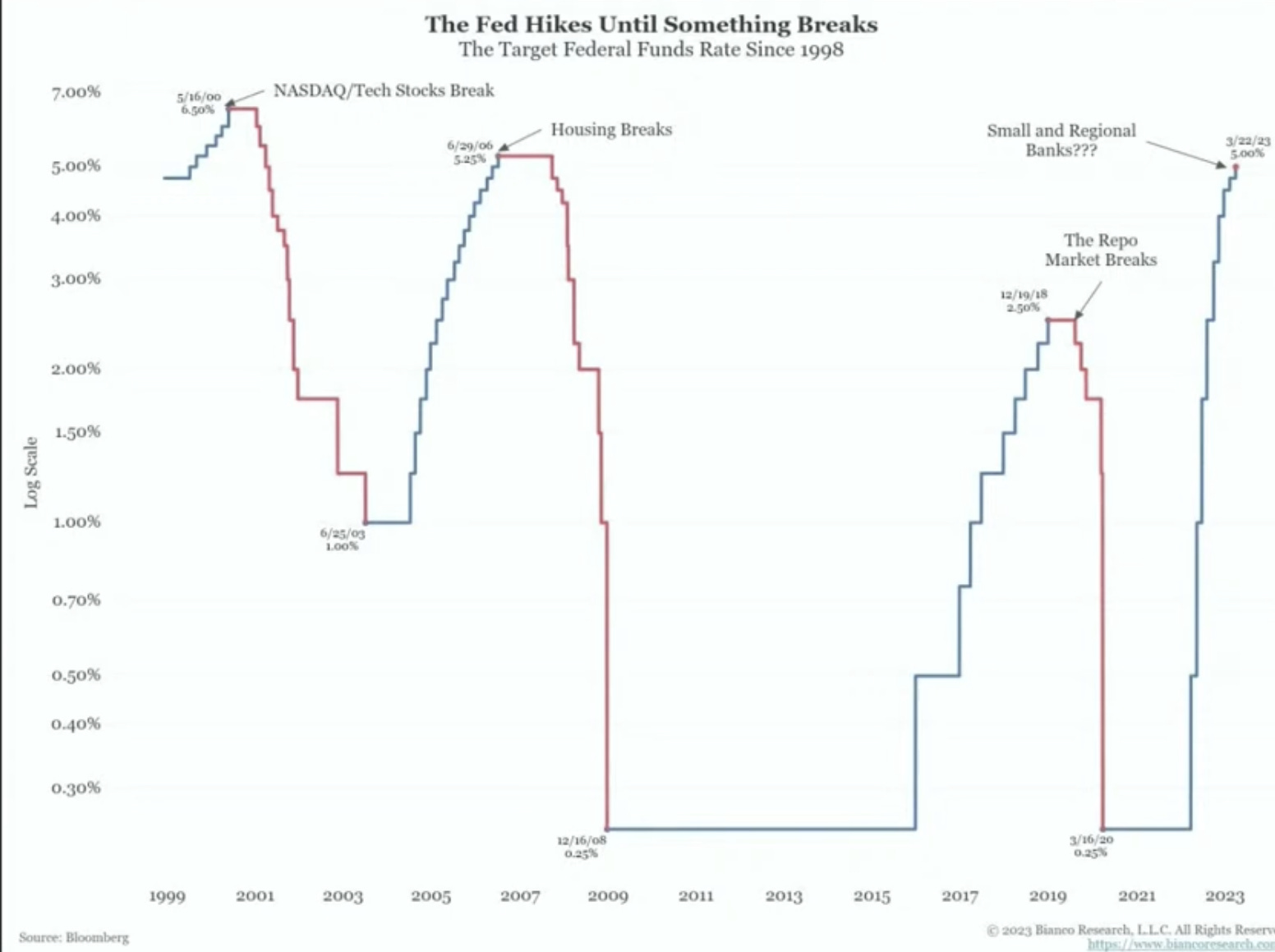
In reality, attempts to inflate the money supply and control inflation through interest rates have spawned cyclical disasters in our economy. Many people believe that these disasters are an unavoidable part of Keynesian economics, but they are actually the product of manipulation. As the Fed prints money to "stimulate the economy," they will inevitably encounter their inflation adversary and be compelled to break the economy in an attempt to reset some of the effects of inflation.
Issues With Fractional Reserve Banking
Furthermore, the current fractional reserve banking system has been shown to be problematic and has led to multiple disasters in the past. The Federal Reserve insures these fractional reserve banks and allows them to lend out up to ten times the amount of reserves held by the bank. This system is under immense pressure today as banks who invested customer deposits are now underwater. Meaning these banks are struggling to meet the demands of their customers who are withdrawing their funds. This could potentially lead to a nationwide bank insolvency issue where the Federal Reserve may have to print an insane amount of money to insure all customer deposits. Currently estimated to be about $2 Trillion but potentially more. In an extreme case where nearly all banks become insolvent, the Federal Reserve may not have enough money to insure all depositors. This is a looming problem that could lead to a centralization of existing banks and a greater expansion of the money supply. Resulting in less trust and higher inflation.
Why Bitcoin Was Originally Created
Considering the value of the dollar is inevitably trending towards zero, which we discussed as essential for maintaining the fiat economic system, it begs the question: Why wait for the dollar to fail to adopt a superior form of money? The adoption of Bitcoin can potentially mitigate the risks associated with traditional banking and monetary policy to pave the way for a more stable and decentralized financial future.
As we witness the US government's ongoing efforts to balance debt and inflation, individuals and even entire nations are exploring alternatives to the US dollar. It is in this context that Bitcoin was created during the 2008 financial crisis, as a response to the inherent flaws in the traditional financial system.
"The root problem with conventional currency is all the trust that's required to make it work. The central bank must be trusted not to debase the currency." (Satoshi Nakamoto)
"Banks must be trusted to hold our money and transfer it electronically, but they lend it out in waves of credit bubbles with barely a fraction in reserve." (Satoshi Nakamoto)
Satoshi Nakamoto, the pseudonymous creator of Bitcoin, recognized the issues arising from a centralized monetary policy and the excessive trust placed in banks and central authorities. As a solution, he created Bitcoin to provide everyone with access to a decentralized, secure, and transparent form of money. This digital currency operates on a peer-to-peer network, removing the need for intermediaries and enabling direct transactions between users. Its underlying technology, blockchain, ensures that all transactions are recorded and verified, fostering trust in the system without the need for a central authority.
Bitcoin's limited supply, capped at 21 million coins, is designed to counter the inflationary tendencies of traditional currencies. Unlike fiat money, which can be printed at will by central banks, Bitcoin's issuance follows a predetermined schedule, making it a deflationary asset. This feature, combined with its decentralized nature, has attracted many to view it as a potential safe haven and alternative to the existing financial system.
Global Dedollarization
As the Federal Reserve continues its reckless money printing practices and the US Government employs sanctions to control global transactions, rival countries are losing faith in its abstract power. Nations such as China, Saudi Arabia, Brazil, India, and South Africa are reportedly developing a new gold-backed currency to challenge the dominance of the US dollar. Consequently, this may lead to a significant decline in demand for the US dollar, especially if it is no longer the primary means of facilitating global oil trade. Such a shift could result in the devaluation of the dollar, culminating in a hyperinflationary environment similar to those experienced by other countries with fiat currencies.
Closing Statements
My mission is to help people understand the current financial system we live in, so they can see its flaws and better manage their risk over the next few decades. With the value of the dollar decreasing due to the inflation that is necessary to sustain the system, it's becoming increasingly important to invest in hard assets.
One of the simplest ways I can communicate the benefits of Bitcoin to people, no matter their level of understanding, is by highlighting its finite supply of 21 million. The first true scarcity we have ever seen and the hardest asset on the planet.
As we navigate through all of this uncertainty in the world today, I'll be sharing my thoughts and insights through weekly or bi-weekly updates on my Substack.
Thanks for reading and subscribe for free to stay in the loop!
Sources
Watcher.Guru. "JUST IN: Brazil, Russia, India, China, and South Africa (BRICS) are developing a new currency, State Duma Deputy Chairman says." Twitter, 30 Mar. 2022,
.
I understand! Thank you for this great explanation.
Very informative.